How a Pendulum Clock Works: The Tick-Tock Science Made Simple


Pendulum clocks look calm on the outside, but inside they run a clever “give-and-take” routine. A weight or spring pushes the gears forward, the pendulum wants to swing at its own pace, and a small part called the escapement keeps both sides honest. That simple teamwork turns motion into steady time.
At Prowaller, we handle these clocks in real life—setup, testing, and repairs—so this guide stays practical, not textbook-heavy. We also sell pendulum wall clocks and common replacement parts (like pendulums, suspension springs, and clock oil) that match this topic.
The three jobs happening inside the clock
1) Power source: weight or spring
A pendulum clock needs stored energy. Some models use a hanging weight; others use a wound mainspring. That energy travels through a gear train that wants to spin continuously.
2) Regulator: the pendulum sets the pace
The pendulum doesn’t “push the hands” directly. It acts like a metronome that decides how fast the gear train may advance.
The key idea: the swing time depends mostly on pendulum length. Physics describes the period as:
T = 2π √(L / g)
So, a longer pendulum swings slower, and a shorter one swings faster. This relationship made pendulums valuable for timekeeping for centuries.
3) Traffic controller: the escapement “releases” the gears
If the gears ran freely, the hands would spin. The escapement stops the gear train, then releases it in tiny steps—tick by tick—based on the pendulum’s swing. It also gives the pendulum a small push to replace energy lost to friction. Most classic pendulum clocks use an anchor escapement (common in wall and longcase clocks). The pendulum moves a fork/crutch, that motion rocks an “anchor” with pallets, and those pallets alternately lock and release the escape wheel teeth. Each release advances the gear train a fixed amount, which moves the hands.
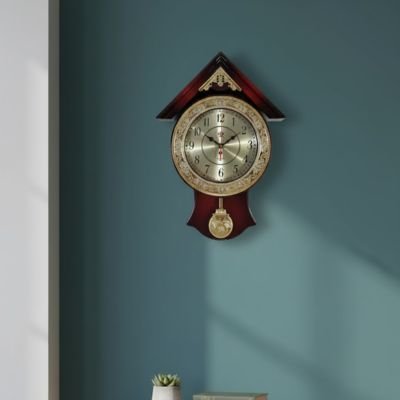
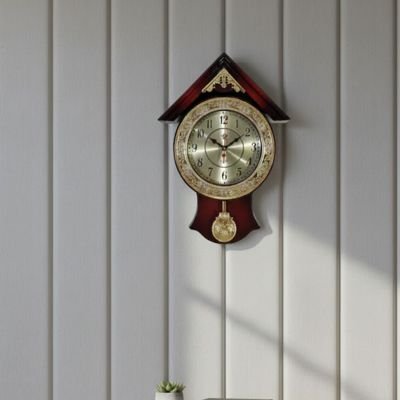
What you’ll find inside a typical pendulum clock
- Power: weight + pulley/chain or a mainspring barrel
- Gear train: reduces speed and increases torque
- Escape wheel: the toothed wheel that advances in steps
- Anchor & pallets: the “gate” that locks/releases the escape wheel
- Crutch/fork: transfers pendulum swing to the escapement
- Pendulum rod + bob: the timekeeper
- Hands & dial: display driven by the gear ratios
Why do pendulum clocks drift?
Even a well-made pendulum clock can gain or lose time. The common causes usually come down to friction, temperature, and setup.
Temperature changes
Metal pendulum rods expand in heat and shrink in cold. That changes the pendulum length and shifts the clock’s rate. Precision clocks historically used temperature-compensated designs like the gridiron pendulum to reduce this effect.
In many Pakistani homes, indoor temperature swings (especially in rooms without steady cooling/heating) can make a noticeable difference over a week.
Humidity, dust, and old oil
Lahore, Karachi, and coastal areas can punish a movement with humidity and dust. Old oil thickens, dust turns it gritty, and friction rises. That changes how the escapement delivers impulse and can affect timekeeping.
Leveling and beat
If the clock isn’t level, the “tick-tock” becomes uneven (out of beat). You’ll hear it: “tick…tock…tick…..tock.” That uneven beat can stop the clock or make it unreliable.
Quick care tips we use at Prowaller
- Keep the clock level and away from door slams and vibrations.
- Avoid direct sunlight on the case and dial.
- Wind weights/springs on a steady routine (many owners pick a weekly time).
- Adjust the rating nut (usually under the bob):
- Raise bob = faster time
- Lower bob = slower time
- Service the movement when oil looks dry/dirty (proper clock oil matters).
FAQs
Why does a pendulum clock tick?
The tick comes from the escapement locking and releasing the escape wheel tooth-by-tooth as the pendulum swings.
Does a heavier pendulum keep better time?
Not automatically. For a simple pendulum, the period depends mainly on length, not bob mass (within normal angles).
Why does my clock run fast in summer?
What is an anchor escapement in simple words?
It’s a gate shaped like an anchor that locks/releases the escape wheel and gives the pendulum tiny pushes each swing.
What should I buy if my pendulum clock stops often?
Common fixes involve replacement suspension springs, proper clock oil, or correcting the beat/level. If parts are worn, a replacement pendulum assembly can help (these are items Prowaller stocks for many standard movements).