What is AM and PM in Clock? History, Meaning, and Examples

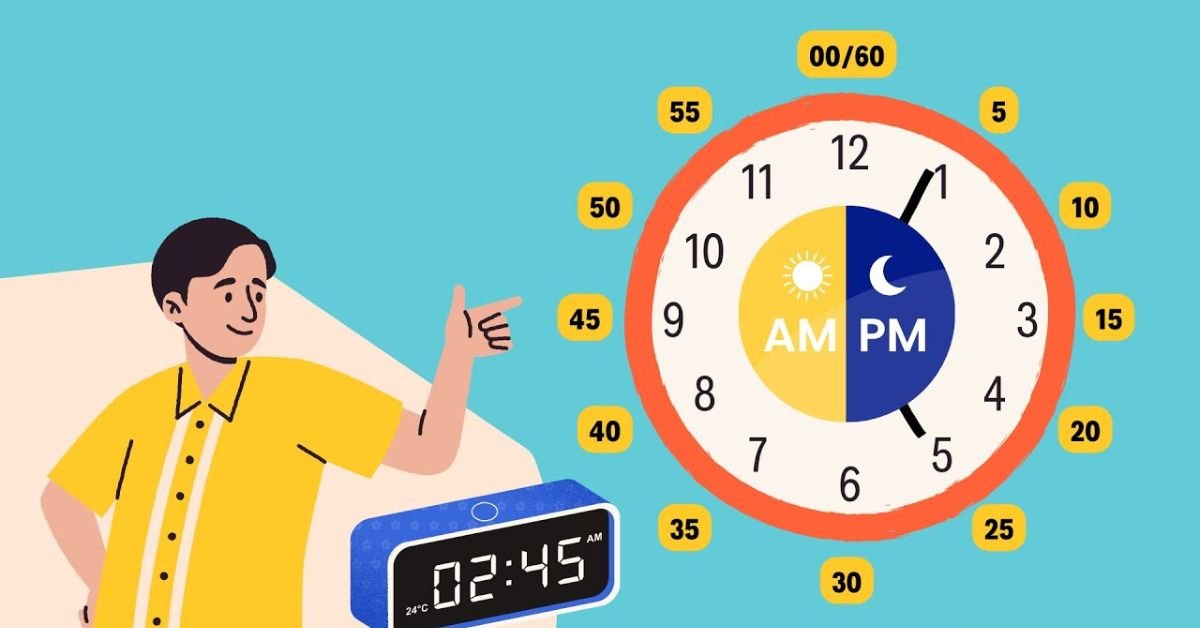
Every wall clock in our homes and offices relies on AM and PM to distinguish morning from evening. AM stands for ante meridiem (Latin for “before midday”) and PM for post meridiem (“after midday”). In the 12‑hour clock system, 12:00 AM marks midnight (the start of the day) and 12:00 PM marks noon. This convention dates back to antiquity, but even today misreading AM vs. PM causes real problems: scheduling apps report businesses losing millions annually to missed meetings and flight bookings gone awry due to time confusion. In short, understanding AM/PM is vital for anyone juggling calendars, travel, or even choosing an analog clock as a piece of home decor.
What Do AM and PM Mean?
Fig: A round analog wall clock (a common home-decor item) shows 10:10. This 12‑hour clock face requires “AM” or “PM” to tell if it’s morning or evening.
In the 12‑hour clock, the day is split into two 12‑hour periods. The first half (midnight to noon) uses AM (“ante meridiem” – before midday) and the second half (noon to midnight) uses PM (“post meridiem” – after midday). For example, 7:00 AM means 7 o’clock in the morning, while 7:00 PM is 7 o’clock in the evening. In writing, “a.m.” and “p.m.” are often added (or simply “AM”/“PM”), though some styles omit the dots.
Analog clocks – such as decorative wall clocks in home decor – typically show only 1 through 12. The same clock face is used twice per day, so a time like 10:10 could be either 10:10 AM or 10:10 PM. Without a label, hearing “the meeting is at 10:10” would be ambiguous. That’s why we append AM/PM or use context (e.g. “in the morning” or “at night”) to clarify. This simple convention of AM/PM reflects the Sun’s position (pre- or post-noon) and is still ingrained in daily life, from school schedules to TV program guides.
Historical Origins of the 12‑Hour Clock
The idea of dividing day and night into 12 parts goes back thousands of years. Ancient Egyptians and Mesopotamians noticed the Sun and stars naturally split time: they had 12 “decans” (star groups) at night and marked 12 daytime hours from sunrise to sunset. The Babylonians inherited a 12‑based time system (linked to zodiac signs) and may have introduced a 12-hour day. The Romans also divided daylight into 12 hours using sundials.
Mechanical clocks emerged in medieval Europe, and early ones often had a 12-hour dial (“small hours”) and a 24-hour dial (“Italian hours”).
Over time, the 12-hour clock became common for everyday use, while the 24-hour clock was reserved for astronomy and technical fields. By the 19th century, many countries had standardized on the 24-hour system for official timetables (e.g. Italy in 1893), but English-speaking nations held onto 12-hour schedules in daily life.
12‑Hour vs. 24‑Hour Time: Traditional and Modern Use
Fig: A smartphone lock screen showing “03:23” on Wed, Mar 4 with a 24-hour clock format. Many digital devices default to 24-hour time (here 03:23) to avoid AM/PM ambiguity.
Today, most of the world uses the 24-hour clock (00:00–23:59) for precision. International standards like ISO 8601 (e.g. 23:45 for 11:45 PM) are common in computing and transit schedules. As one source notes, the 24-hour system “is the most commonly used time notation in the world”. For example, military operations, airlines, hospitals and global businesses use 24h time so there’s no confusion. Digital devices tend to follow suit: most computers and smartphones default to 24-hour format unless explicitly set otherwise.
By contrast, the 12-hour clock (with AM/PM) is still widely used in casual speech and print media in certain countries. This includes the United States, India, Canada (outside Quebec), New Zealand, Australia and some others. In these places you’ll see wall clocks, TV guides and daily schedules labeled with “AM” and “PM.” Even in such countries, specialized sectors switch to 24h when clarity is critical. For example, U.S. hospitals, aviation and military forces routinely use 24h time to avoid errors.
In sum, modern life blends both systems. In global communications, one often converts AM/PM times to the corresponding 24h times (“2 PM” = 14:00). Smartphone apps and digital calendars usually allow you to choose your preferred format. But the legacy of AM/PM remains strong in everyday language and in the design of analog clocks – especially those popular in home decor – where “morning” vs. “afternoon” still needs to be stated explicitly.
Common Confusions and Misinterpretations
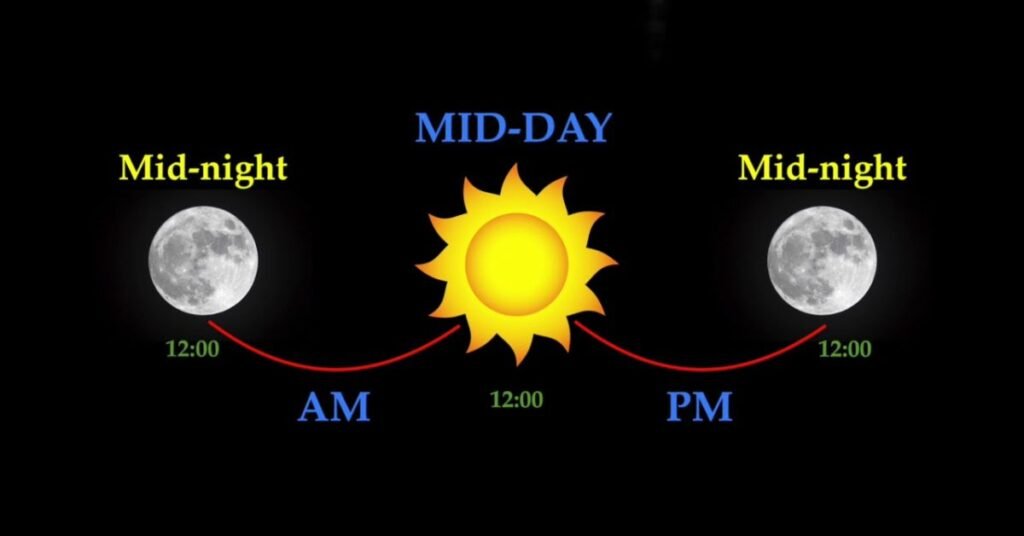
Despite its simplicity, the 12-hour system causes frequent mix-ups. A classic example is 12:00 noon vs. midnight. Technically, 12:00 PM is noon and 12:00 AM is midnight, but many people get this backwards. As one writer notes: “The most frequent error involves incorrectly assuming 12:00 AM represents noon rather than midnight”. In practice, phrases like “12:30am lunch meeting” or “12 midnight appointment” often reveal confusion.
Another ambiguity arises when AM/PM is omitted entirely. Saying “meeting at eight o’clock” without specifying morning or evening can lead to a 12‑hour misfire. Even written schedules can mislead: a plain “12/5/26, 8:00” is useless without an AM/PM marker or context. Context cues like “in the morning” or “at night” are often used to clarify in speech, but written or digital appointments need one or the other explicitly.
International communication adds another layer of risk. For example, a European colleague might use “00:30” (24h) for half past midnight, while an American might write “12:30 AM.” This can cause a 12-hour error if one side assumes the other’s convention. In fact, travel blogs report thousands of missed flights every year because passengers misread “AM” vs “PM” on their tickets. One review cites passengers arriving a full 12 hours early or late for red-eye flights due to this confusion.
In everyday life this can mean oversleeping, missing a work call or arriving at an empty office. Schools and offices often mitigate this by writing “12:00 noon” or “12:00 midnight” explicitly. In digital tools, setting time zones correctly is crucial: time-zone conversion can also invert AM/PM if not handled properly. In short, anytime critical scheduling is involved, a careless omission of AM/PM (or reliance on it) can have outsized consequences.
Real-World Impacts of Time-Format Errors
- Business and meetings: Companies estimate that time mix-ups cost millions of dollars annually in wasted meetings and productivity loss. Scheduling tools and HR policies often emphasize clear time formats for this reason. In high-pressure environments, one report found professionals make roughly 23% more scheduling errors due to AM/PM confusion, especially outside normal work hours.
- Travel and transportation: Airlines and transit agencies frequently highlight departure times with AM/PM labels or use 24-hour stamps. Still, travelers often err. For example, a red-eye flight listed as “12:30 AM” might be mistaken for a midday flight, leading to missed departures. Industry observers note “thousands of missed flights annually” stem from such mix-ups. Tour operators advise double-checking whether a time is truly after midnight or after noon.
- Healthcare and safety: In medicine, even minor timing errors can be dangerous. Hospitals often use 24-hour charts to log medications and vitals to eliminate AM/PM ambiguity. The same is true for military and emergency services. A study cited cases of life-critical mistakes (e.g. insulin dosing) when devices were set to the wrong AM/PM. Similarly, law enforcement and firefighting schedules avoid confusion by using a 24-hour clock or appending “hours” (e.g. “17:00 hours”) to cut errors.
- Legal and contracts: Missed deadlines due to timing misunderstandings have even ended up in court. Some legal agreements now insist on dual notation: e.g. “Contract expires at 12:00 PM (12:00) on Oct 1” to prevent dispute. International deals often favor the 24-hour format in parentheses for clarity.
Overall, real-world evidence shows that AM/PM misinterpretation isn’t just trivia – it can disrupt travel plans, business deals, and safety protocols. Modern organizations increasingly treat precise time notation as a compliance issue.
Practical Tips to Avoid AM/PM Mix-Ups
- Use 24-hour notation where possible. For schedules, schedules and digital calendars, prefer “14:00” instead of “2:00 PM.” This removes doubt entirely. Many phones and computers let you choose 24-hour time in settings.
- Spell out “noon” and “midnight.” Instead of writing “12:00 PM” or “12:00 AM,” say “12:00 noon” or “midnight.” This simple shift eliminates the trickiness around 12 o’clock. For example, a dinner at “12:30 noon” is unambiguous.
- Include context in written communications. If you must use AM/PM, add qualifiers: “Monday 8:00 AM (morning)” or “Friday 12:15 AM (just after midnight).” Some teams even annotate with time zones and format (e.g. “2:00 PM EST (14:00 GMT)” for global meetings).
- Double-check bookings and tickets. When receiving flight/train tickets or meeting invites, confirm AM/PM immediately. Travel sites often allow toggling between 12- and 24-hour views – use that feature.
- Sync your devices. Digital clocks, phones and smart home devices sometimes swap formats based on region. Make sure your device’s format matches your preference (see the smartphone example above). Setting all your devices the same way reduces the chance of misreading a notification.
- Train teams and family. In offices and at home, remind people that “PM” is after noon. A quick cheat-sheet (e.g. “If you ever see 12:30 PM, think ‘sunny lunch’ – not midnight!”) can help. When scheduling with others, always confirm “AM or PM?” to avoid assumptions.
Following these guidelines will help avoid the costly and common pitfalls of 12-hour timekeeping. Consistency is key: once a clear notation is chosen, stick to it throughout the day’s planning.
Conclusion
The AM/PM system is a centuries-old timekeeping convention built into nearly every analog clock and many daily routines. While it may seem quaint in our 24/7 digital era, AM and PM continue to matter for scheduling flights, meetings and social events. Key insights from research and industry practice include: always clarify the context of 12:00, favor 24-hour notation for critical communication, and double-check when crossing time zones or midnight boundaries.
In the future, smart devices and international standards may gradually phase out everyday AM/PM use, but for now it remains deeply embedded in language and culture. Whether you hang a stylish analog clock as home decor or glance at your phone at night, remembering that “ante meridiem” means before midday and “post meridiem” means after will keep your appointments on track. By combining traditional time wisdom with modern tools, we can minimize AM/PM confusion and keep our daily schedules running smoothly.